
How to Perform Ghusl Step by Step
How to perform ghusl: when ghusl is required, what makes it valid, the recommended steps in order – and a gentle way to teach it to pre-teens.
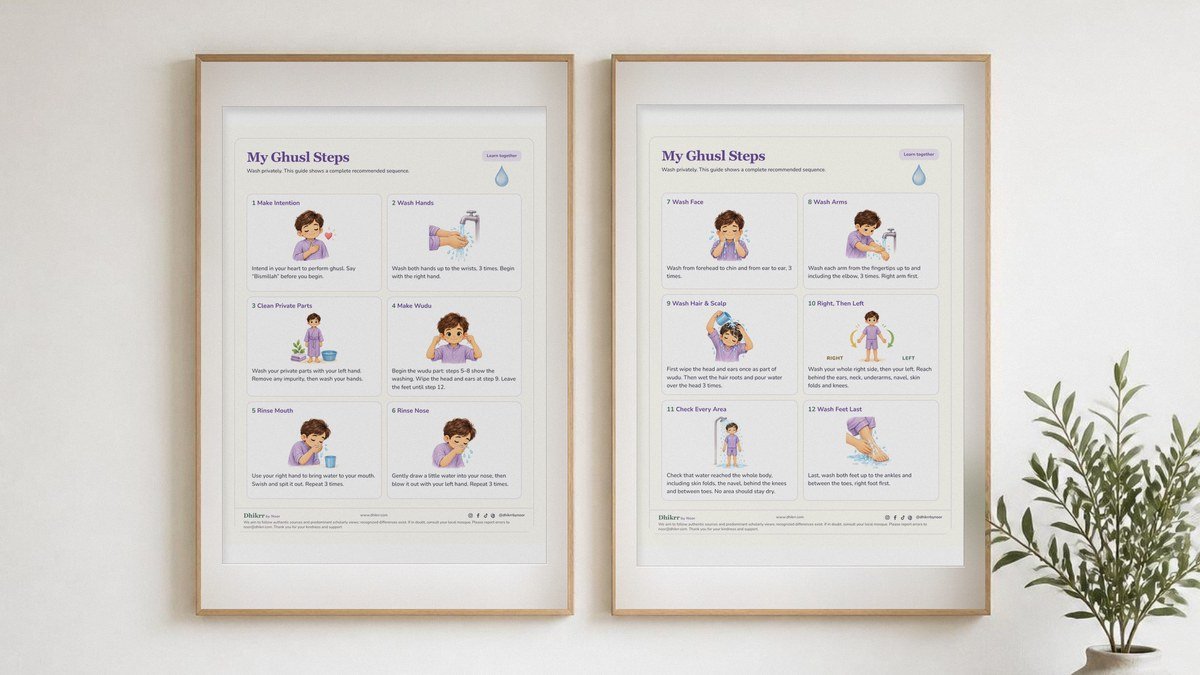
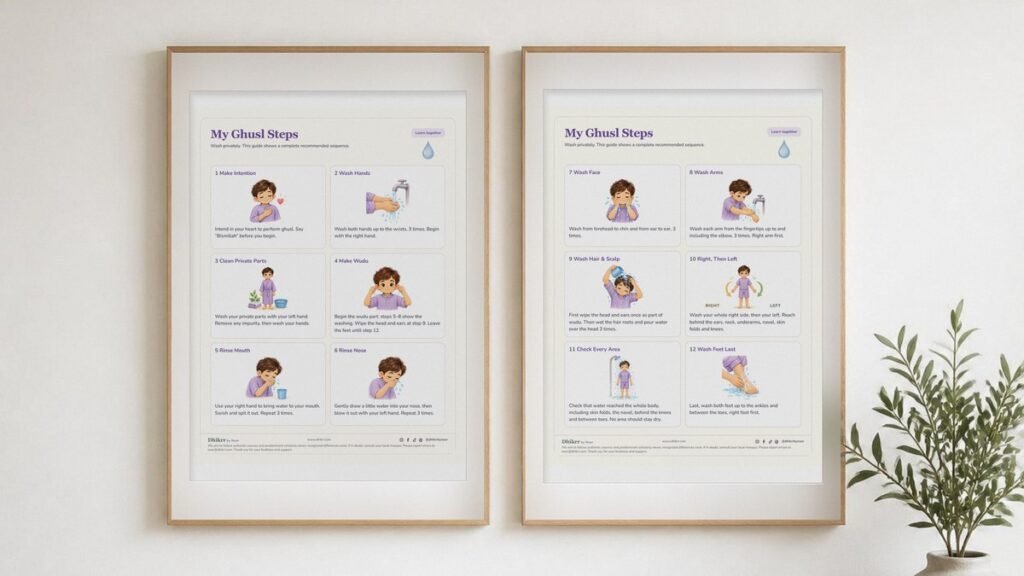
Ghusl is the full ritual bath in Islam. It is valid when you make the intention and water reaches your entire body, including the hair roots (and, in many schools, rinsing the mouth and nose). The Sunnah way follows a recommended order: intention and Bismillah, washing the hands, cleaning the private parts, a full wudu, pouring water over the head three times, then washing the right side and the left side of the body.
In this guide
When is ghusl required?
- After sexual intercourse or any discharge of semen.
- After menstruation and post-natal bleeding end.
- For a person who embraces Islam (according to many scholars).
- For the deceased (washed by others).
Ghusl is also recommended (Sunnah) before Jumu’ah, the two Eids and entering ihram.
What makes ghusl valid
Scholars agree on two essentials: the intention and water reaching the whole body, including the scalp and hair roots. The Hanafi school also requires rinsing the mouth and nose. Everything else in the steps below is Sunnah – rewarded, but the ghusl is valid without it.
The Sunnah steps in order
Intention & Bismillah
Intend ghusl in your heart.
Wash the hands
Three times.
Clean the private parts
With the left hand, then wash the hands again.
Make wudu
Rinse mouth and nose, wash face and arms, wipe head and ears – you may leave the feet for the end.
Wash the hair
Run wet fingers through to the roots and pour water over the head three times.
Right side, then left
Pour water over the right side of the body, then the left.
Whole body
Make sure water reaches every part: behind the ears, the navel, underarms, behind the knees.
Wash the feet
If you left them, wash them last.
“When the Messenger of Allah ﷺ performed ghusl for janabah, he began by washing his hands, then he performed wudu as for prayer, then he put his fingers in the water and ran them through the roots of his hair, then poured three handfuls of water over his head, then poured water over his whole body.”
‘A’ishah · Sahih al-Bukhari 248
Free printable
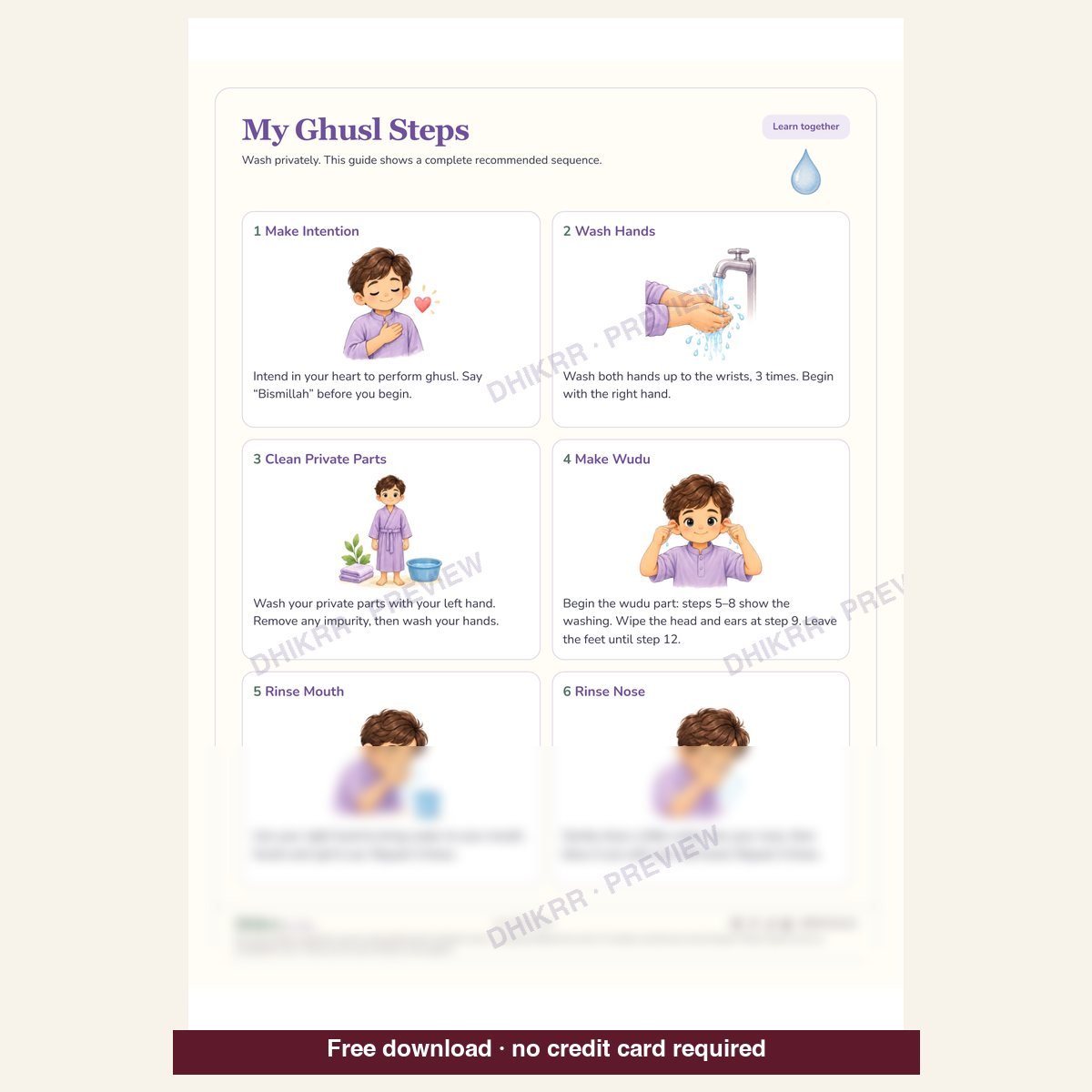
Ghusl Steps – Free Printable Guide
12 illustrated steps of the ritual bath in the recommended order. Free by email.
Get it freeHow to teach ghusl to pre-teens
Ghusl is part of the conversation about puberty – a sensitive but essential topic. A few tips:
- Talk before puberty begins (around 9–11), calmly and privately.
- Mothers with daughters, fathers with sons, when possible.
- Explain it as purification and worship, not embarrassment.
- Give them a discreet visual guide they can keep in the bathroom.
Parent tip
Teach wudu first and well – ghusl builds on it. See our wudu guide for kids.
Free printable
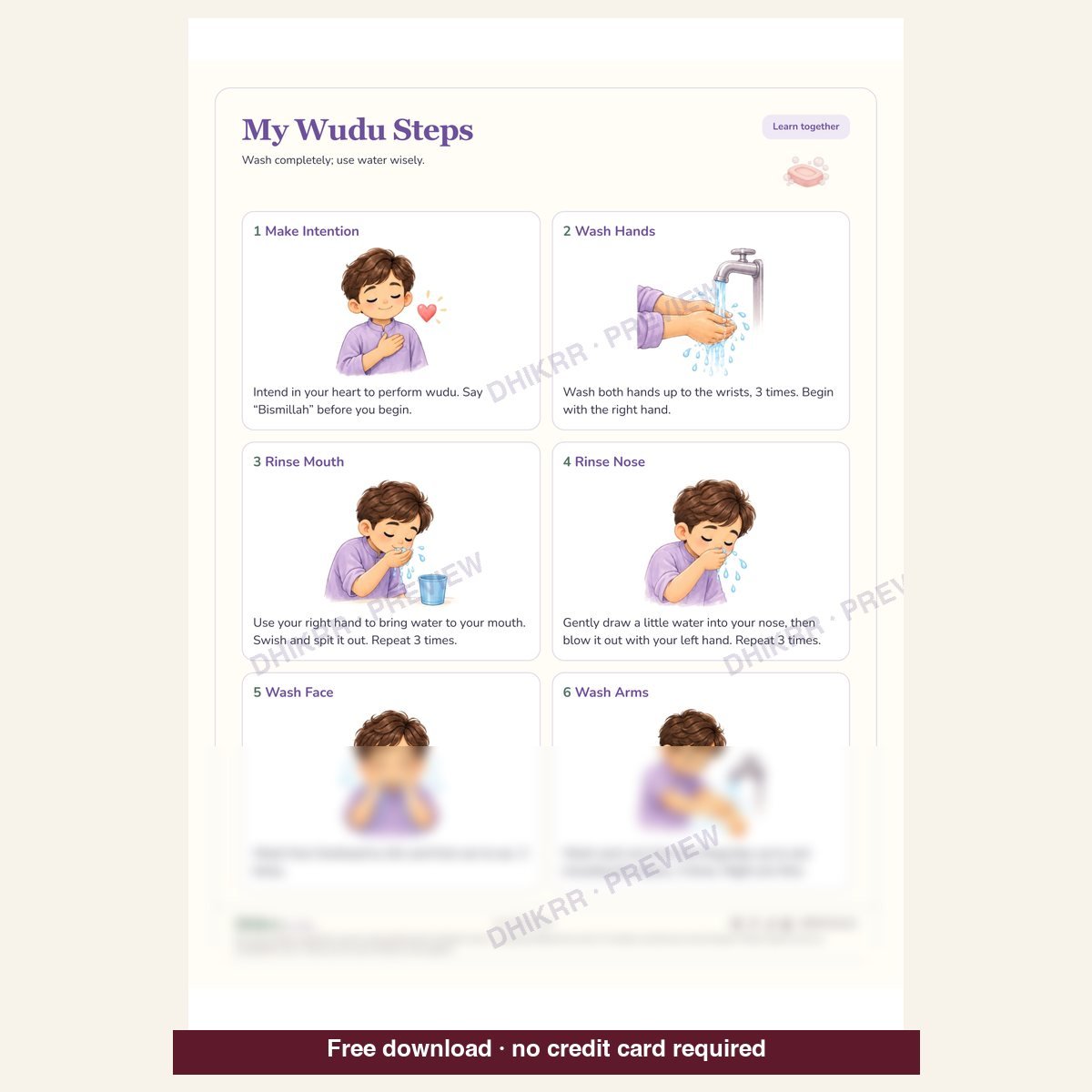
Wudu Steps for Kids – Free Poster
9 illustrated steps of wudu kids can follow on their own. Get the PDF free by email.
Get it freeFree printables for your family
Wudu & prayer posters, 40 Rabbana duas, duas for your child… one email unlocks the whole library – plus a personal 10% code.
Frequently asked questions
What are the fard (obligatory) acts of ghusl?
The intention and making water reach the entire body, including the hair roots. The Hanafi school adds rinsing the mouth and the nose.
Does ghusl count as wudu?
Yes, according to most scholars a complete ghusl also lifts the minor impurity, so you can pray without a separate wudu – unless something breaks wudu afterwards.
Do women have to undo their braids for ghusl?
For ghusl after janabah, women do not have to undo braids as long as water reaches the roots (Sahih Muslim 330). Many scholars recommend undoing them after menstruation.

We create authentic, beautiful Islamic tools for Muslim families. Every dua and hadith we share is checked against its source.