
10 Daily Duas for Kids, With Arabic, Transliteration & Meaning
Daily duas for kids: short, authentic supplications for the moments that fill a child’s day – and a gentle, proven way to help them remember each one.

Every parent knows the feeling: you want your child to grow up loving Allah, not just knowing about Him. Daily duas are one of the simplest ways to get there. A few words before a meal, at the door or at bedtime, and an ordinary routine becomes a moment of remembrance.
Below are ten essential duas for children, each with the Arabic text, an easy transliteration, its meaning and its source. You don’t need to teach them all at once. Start with one, practice it at the right moment, and let it become part of your family’s rhythm.
In this guide
The duas of the day
01 · Before eating
بِسْمِ اللَّهِ
Bismillah
“In the name of Allah.”
Abu Dawud · Tirmidhi
The very first dua most children learn – and the easiest. If your child forgets at the start of the meal, teach them the “catch-up” version: Bismillahi awwalahu wa akhirahu, “In the name of Allah, at its beginning and at its end.”
02 · After eating
الْحَمْدُ لِلَّهِ الَّذِي أَطْعَمَنِي هَذَا وَرَزَقَنِيهِ مِنْ غَيْرِ حَوْلٍ مِنِّي وَلَا قُوَّةٍ
Alhamdu lillahil-ladhi at’amani hadha wa razaqanihi min ghayri hawlin minni wa la quwwah
“Praise be to Allah who fed me this and provided it for me, without any power or strength of my own.”
Abu Dawud · Tirmidhi
A beautiful lesson in gratitude: every meal is a gift, not something we earned alone. For younger children, a simple Alhamdulillah is a perfect start.
03 · Before sleeping
بِاسْمِكَ اللَّهُمَّ أَمُوتُ وَأَحْيَا
Bismika Allahumma amutu wa ahya
“In Your name, O Allah, I die and I live.”
Sahih al-Bukhari
04 · When waking up
الْحَمْدُ لِلَّهِ الَّذِي أَحْيَانَا بَعْدَ مَا أَمَاتَنَا وَإِلَيْهِ النُّشُورُ
Alhamdu lillahil-ladhi ahyana ba’da ma amatana wa ilayhin-nushur
“Praise be to Allah who gave us life after causing us to die, and to Him is the return.”
Sahih al-Bukhari
Bedtime and wake-up duas work wonderfully as a pair: they open and close the day with Allah’s name. Say them together at the bedside, every night and every morning.

05 · Leaving the house
بِسْمِ اللَّهِ، تَوَكَّلْتُ عَلَى اللَّهِ، وَلَا حَوْلَ وَلَا قُوَّةَ إِلَّا بِاللَّهِ
Bismillah, tawakkaltu ‘alallah, wa la hawla wa la quwwata illa billah
“In the name of Allah, I place my trust in Allah; there is no power and no strength except with Allah.”
Abu Dawud · Tirmidhi
06 · Entering the bathroom
بِسْمِ اللَّهِ، اللَّهُمَّ إِنِّي أَعُوذُ بِكَ مِنَ الْخُبُثِ وَالْخَبَائِثِ
Bismillah, Allahumma inni a’udhu bika minal-khubuthi wal-khaba’ith
“In the name of Allah. O Allah, I seek refuge in You from all evil and evil beings.”
Sahih al-Bukhari · Sahih Muslim
Parent tip
Teach this dua outside the bathroom – at the door – and let your child say it just before stepping in. Words of remembrance are not said inside.
07 · Leaving the bathroom
غُفْرَانَكَ
Ghufranak
“I seek Your forgiveness.”
Abu Dawud · Tirmidhi
08 · When sneezing
الْحَمْدُ لِلَّهِ
Alhamdulillah
“Praise be to Allah.” The listener replies Yarhamuk-Allah (“May Allah have mercy on you”), and the one who sneezed answers Yahdikumullahu wa yuslihu balakum (“May Allah guide you and set your affairs right”).
Sahih al-Bukhari
Children love this one because it’s a conversation – it turns a sneeze into a little exchange of kindness between siblings.
09 · Before studying
رَبِّ زِدْنِي عِلْمًا
Rabbi zidni ‘ilma
“My Lord, increase me in knowledge.”
Quran · Surah Ta-Ha 20:114
10 · When it rains
اللَّهُمَّ صَيِّبًا نَافِعًا
Allahumma sayyiban nafi’a
“O Allah, make it a beneficial rain.”
Sahih al-Bukhari
5 tips to help your child remember
Tie each dua to a moment
Say it at the exact time, every time. Repetition in context is what makes it stick.
Keep the words in sight
Cards on a ring, or a printed dua list placed where each dua is said, act as gentle, silent reminders.
Celebrate, never test
A star on a chart or a warm “MashaAllah!” works far better than quizzing.
Let them hear you
Children copy what they see. Say your own duas out loud.
One per week
Consistency beats speed. Ten duas in ten weeks is a beautiful achievement.
“The most beloved deeds to Allah are those done consistently, even if they are small.”
Sahih al-Bukhari · Sahih Muslim

Make it easy
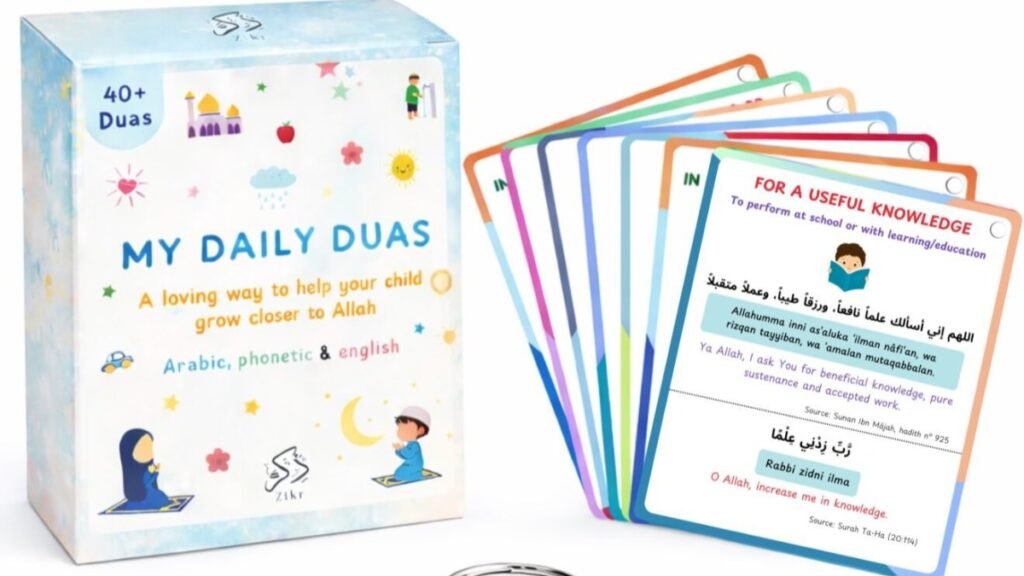
Islamic Dua Flashcards for Kids
40+ daily duas with Arabic, transliteration and English on durable laminated cards – plus a free prayer tracker.
Shop the flashcardsFrequently asked questions
At what age can children start learning duas?
As early as they can speak. Toddlers can start with “Bismillah” and “Alhamdulillah”; by 4–6 years old most children can learn the full daily duas with a little repetition.
Should my child learn the Arabic or the meaning first?
Both, together. Saying the Arabic connects them to the words of the Prophet ﷺ, and knowing the meaning makes the dua sincere. Transliteration is a helpful bridge until they read Arabic.
How many duas should we learn at once?
One new dua per week is plenty. Keep reviewing the previous ones at their natural moments.

We create authentic, beautiful Islamic tools for Muslim families. Every dua we share is checked against its source.